
RETHINKING CARDIAC PACING

A Next-generation Implantable Epicardial Leadless Pacemaker Platform
A Next-generation Implantable Epicardial Leadless Pacemaker Platform

EPIPACE is developing a next-generation implantable epicardial leadless pacemaker designed to address the long-term limitations of conventional cardiac pacing. The platform is intended to reduce dependence on transvenous leads, avoid chronic intracardiac hardware, and support longer-term pacing with fewer repeat interventions

Children who require permanent pacing may face repeated generator replacements, lead revisions, and reoperations as they grow. Fractured or abandoned wires may remain within the venous system and heart, increasing the complexity of future procedures and creating cumulative lifetime risk
EPIPACE is being developed as a leadless epicardial platform intended to reduce dependence on chronic intracardiac wires and repeated system replacement

Conventional right-ventricular pacing can create electrical and mechanical dyssynchrony and may contribute to progressive left-ventricular dysfunction in susceptible patients.
EPIPACE is designed for epicardial placement on the left ventricle and incorporates a patented multi-receiver architecture intended to coordinate stimulation across multiple cardiac locations. Sequential activation from the apex toward the base and along the natural orientation of myocardial fibers is designed to support a more physiologic, spiral pattern of ventricular contraction
Designed to stimulate the left ventricle directly from the external surface of the heart and potentially reduce the adverse effects associated with isolated right-ventricular pacing
Patented receivers positioned across the ventricles and interventricular septum are designed to sense cardiac activity and deliver coordinated electrical stimulation
Timed stimulation from the apex toward the base is intended to reproduce the heart’s natural torsional contraction and improve ventricular coordination
This architecture may expand EPIPACE beyond conventional bradycardia pacing toward the prevention of pacing-induced ventricular dysfunction and the treatment of selected heart-failure patients
Heart-failure prevention, resynchronization, and multi-site spiral pacing are investigational applications that require further engineering validation, preclinical evaluation, regulatory review, and clinical studies.
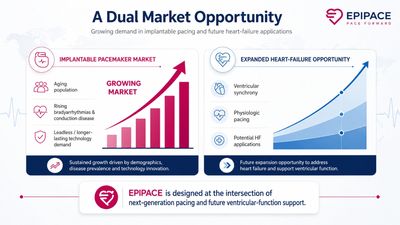
The implantable pacemaker market continues to expand as populations age and the prevalence of bradyarrhythmias, conduction disease, and heart failure rises. Demand is also increasing for technologies that reduce lead-related complications, preserve ventricular function, and limit repeated replacement procedures
Age-related conduction disease is increasing the number of patients who require permanent pacing
More patients are living longer with arrhythmias, pacemakers, and heart-failure risk.
Healthcare systems are increasingly seeking leadless, physiologic, and longer-lasting pacing solutions